The technology industry is one of the fastest-growing sectors in the world, creating millions of opportunities for individuals with digital skills. From software development and data analysis to cybersecurity, artificial intelligence, digital marketing, and UI/UX design, employers are increasingly searching for people who can solve problems and deliver results.
However, one major challenge facing many aspiring tech professionals is the gap between knowing and doing.
Many people spend months learning theories, watching tutorials, and reading materials, yet struggle when asked to work on real projects. This is why practical training has become one of the most important aspects of modern tech education.
If you are planning to learn technology skills in Nigeria, understanding the importance of practical training can help you choose the right training institute and significantly improve your chances of success.
What is Practical Training in Tech?
Practical training refers to learning by doing. Instead of focusing solely on theories and concepts, students actively work on projects, assignments, simulations, and real-world scenarios.
Examples of practical training include:
- Building websites during web development classes
- Creating dashboards in data analysis courses
- Designing mobile applications in UI/UX training
- Running live advertising campaigns in digital marketing
- Performing security assessments in cybersecurity programs
Practical learning allows students to apply concepts immediately and gain hands-on experience.
Why Theory Alone Is No Longer Enough
Theory remains important because it provides foundational knowledge. However, technology is a skill-based industry where employers and clients prioritize competence over memorization.
A person may understand programming concepts but still struggle to write functional code.
Similarly, someone may understand digital marketing terms but be unable to create or optimize campaigns.
Today’s employers are increasingly asking questions such as:
- What projects have you completed?
- Can you demonstrate your skills?
- Do you have a portfolio?
- Have you solved real problems?
The ability to answer these questions often matters more than certificates alone.
1. Practical Training Builds Real Skills
Technology is similar to learning how to drive a car.
You cannot become a good driver by reading manuals alone.
Likewise, you cannot become a competent software developer, data analyst, or digital marketer simply by reading books.
Practical training helps learners:
- Understand industry tools
- Build confidence
- Develop problem-solving abilities
- Gain hands-on experience
The more you practice, the more competent you become.
2. It Improves Knowledge Retention
Research consistently shows that people remember more when they actively participate in learning.
Reading about a concept may help temporarily, but applying it through projects creates deeper understanding.
Students who work on real projects tend to retain knowledge for much longer than those who rely solely on theory.
This is why practical-based learning is becoming the preferred approach in modern tech education.
3. Employers Want Job-Ready Professionals
The technology industry is highly competitive.
Companies are increasingly seeking candidates who can contribute immediately rather than individuals who require extensive retraining.
Practical training prepares students for real work environments by exposing them to:
- Industry tools and software
- Team collaboration
- Project execution
- Problem-solving techniques
- Professional workflows
Employers value individuals who can demonstrate practical competence.
4. Practical Training Helps You Build a Portfolio
One of the biggest advantages of hands-on learning is portfolio development.
A portfolio serves as proof of your abilities.
Examples include:
- Websites you have built
- Data dashboards you have created
- Graphic designs and branding projects
- Mobile application prototypes
- Marketing campaigns
- Cybersecurity case studies
Having a strong portfolio significantly increases your chances of securing jobs, internships, remote opportunities, and freelance projects.
For many technology roles, portfolios often carry more weight than academic qualifications.
5. It Increases Confidence
Many beginners struggle with self-doubt because they have not had enough opportunities to practice.
Practical training helps students gain confidence by allowing them to work through challenges and achieve measurable results.
Confidence grows when learners successfully complete projects and realize that they can solve real problems.
This confidence becomes extremely valuable during:
- Job interviews
- Client meetings
- Freelancing engagements
- Team collaborations
6. Practical Training Encourages Problem-Solving
Technology is fundamentally about solving problems.
In real workplaces, professionals are constantly required to:
- Identify issues
- Analyze data
- Test solutions
- Fix errors
- Improve systems
These skills cannot be fully developed through theoretical study alone.
Hands-on projects expose students to real challenges and teach them how to think critically and find solutions independently.
7. It Prepares Students for the Future of Work
The future of work is increasingly skills-driven.
Employers across the world are shifting toward skills-based hiring rather than relying solely on degrees and certifications.
Remote jobs, freelancing platforms, startups, and multinational companies are increasingly assessing candidates based on:
- Demonstrable skills
- Project experience
- Technical portfolios
- Practical competence
This makes practical training more important than ever before.
Why Bizmarrow Technologies Emphasizes Practical Learning
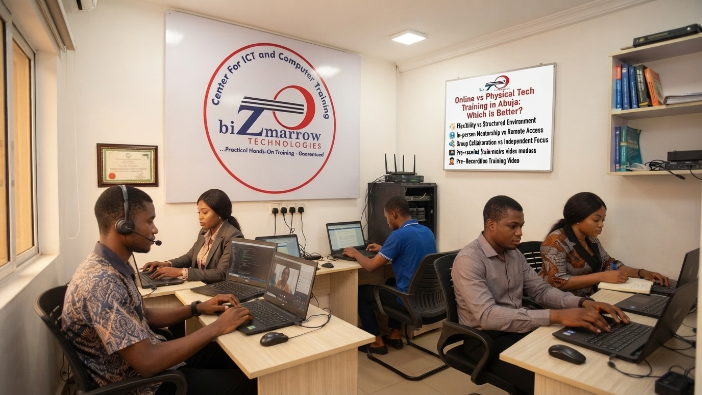
At Bizmarrow Technologies, practical training is at the core of every program.
The institution recognizes that students need more than theoretical knowledge to succeed in today’s digital economy.
What Makes Bizmarrow Different?
1. Project-Based Learning
Students work on real-life projects throughout their training programs.
2. Industry-Relevant Curriculum
Courses are regularly updated to reflect current industry trends and emerging technologies.
3. Experienced Instructors
Students are guided by trainers who provide practical support and mentorship.
4. Career Development Support
Beyond technical skills, students receive training in employability, portfolio development, and professional readiness.
5. Personalized Learning Environment
Smaller class sizes ensure students receive adequate attention and support.
Bizmarrow offers practical training in several in-demand areas including:
- Data Analysis and Visualization
- Digital Marketing
- Web Development
- Cybersecurity
- UI/UX Design
- Artificial Intelligence
- Cloud Computing
- Robotics and Coding
- Graphic Design
- Video Editing and Content Creation
Learn Practical Tech Skills at Bizmarrow Technologies Abuja
If you are looking for one of the best places to acquire practical digital skills in Abuja, Bizmarrow Technologies provides flexible online and physical training programs.
Central Business District Office
Suite B106 & B108, Millennium Plaza, Opposite NNPC Towers, Herbert Macaulay Way, Central Business District, Abuja.
Gwarinpa Office
Suite 10 & 15, H-MEDIX Building, 2nd Avenue, Gwarinpa, Abuja.
Website: http://www.bizmarrow.com/
Final Thoughts
Theory provides the foundation for learning, but practical experience transforms knowledge into real skills.
In today’s technology industry, employers and clients are looking for individuals who can build, create, analyze, and solve problems.
This is why practical training matters more than theory alone.
Whether your goal is to secure employment, become a freelancer, launch a business, or work remotely, hands-on learning significantly increases your chances of success.
Choosing a training institution that emphasizes practical education can make all the difference, and Bizmarrow Technologies continues to position itself as one of Nigeria’s leading centers for practical, career-focused digital training.
Frequently Asked Questions (FAQs)
1. Why is practical training important in tech?
Practical training helps learners apply concepts, build projects, develop confidence, and become job-ready.
2. Is theory important in technology education?
Yes. Theory provides foundational knowledge, but practical experience is necessary to develop real competence.
3. Do employers prefer practical skills?
In many cases, yes. Employers increasingly prioritize portfolios, projects, and demonstrable skills over certificates alone.
4. What is project-based learning?
Project-based learning involves students working on real-world assignments and practical projects during training.
5. Which tech skills require practical training?
Virtually all technology skills benefit from practical learning, including:
- Software Development
- Data Analysis
- Cybersecurity
- Digital Marketing
- UI/UX Design
- Graphic Design
- Artificial Intelligence
6. Can beginners benefit from practical training?
Absolutely. Practical learning helps beginners understand concepts faster and build confidence.
7. Where can I learn practical tech skills in Abuja?
Bizmarrow Technologies is one of the leading digital training institutions in Abuja, offering practical and project-based training in various in-demand technology fields.
8. How can I register for courses at Bizmarrow Technologies?
Visit http://www.bizmarrow.com/ to explore available programs and register for upcoming training sessions.